
Bus Fever Party!
Lumi GamesCasual
4.11.14K Reviews
- Version
- 1.2.9
- Installs
- 10.00M
- Age Rating
- Everyone
Screenshots

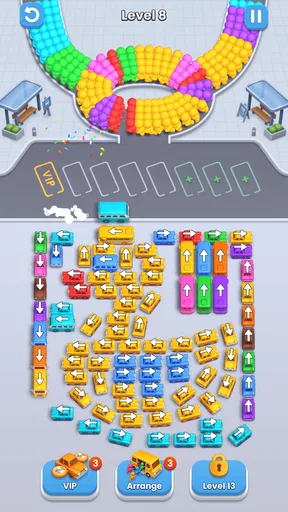
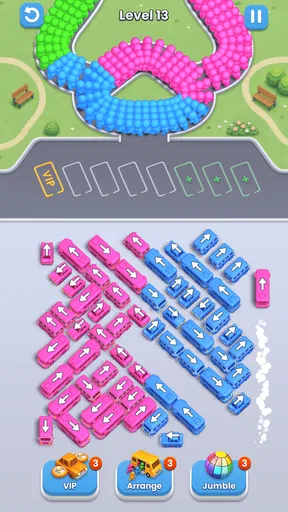
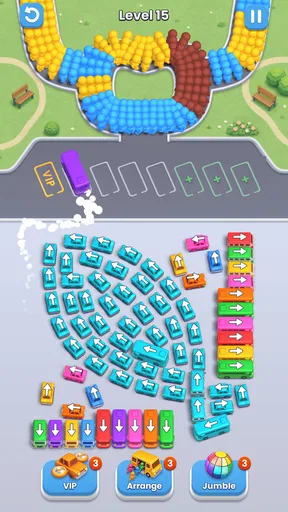
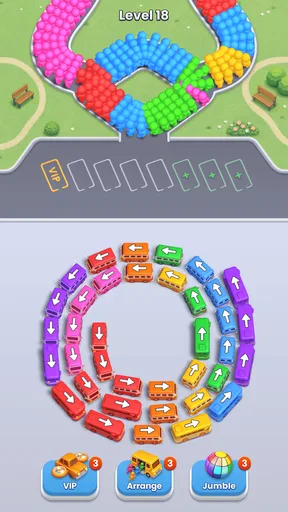
Our Review of Bus Fever Party!
 Analysis by Appyee
I expected Bus Fever! Car Jam Escape to be a simple traffic puzzle, but my first sessions showed a more focused personality. The idea is easy to understand: buses are packed into a congested space, and I need to sort them out before the jam becomes impossible to manage. That familiar setup gives the game an immediate pick-up-and-play quality, while the offline format makes it especially convenient for short breaks, travel, or moments when I do not want to depend on a connection.
What held my attention was not a complicated story or a large collection of systems. It was the small pressure created by choosing the right bus movement at the right moment. A careless action can close useful routes, while a patient sequence can gradually open the whole scene. I found myself restarting some situations not because the controls were difficult, but because I had recognized a better order of operations.
Lumi Games presents this as a casual game, and that description fits the way it feels in the hand. It is approachable enough for someone who normally avoids demanding puzzle games, yet it still gives experienced players something to think about when the layout becomes crowded. The game is free to start, with optional in-app purchases ranging from $1.99 to $99.99 per item, so I would recommend treating it as a free trial of the core experience rather than assuming every part of the long-term experience will be equally frictionless.
A small traffic world with a clear visual language
The strongest part of the presentation is its clarity. In a traffic puzzle, visual confusion can make a fair challenge feel random, so the important objects need to be readable at a glance. Here, the buses and the blocked routes form the central visual conversation. I can look at the board, identify what is trapped, and begin thinking about which movement will create space instead of spending time decoding decorative details.
That restrained approach gives the game a coherent mood. The setting feels busy because of the traffic problem, but the presentation does not need to become visually aggressive. I get the sense of urban congestion without being pushed into a dramatic or stressful atmosphere. This matters because the game is designed for repeated short sessions: a loud, visually overloaded style would make the same puzzle loop tiring much faster.
I also like how the subject matter supports the mechanics. The buses are not an arbitrary collection of colored pieces placed on a grid; they give the sorting challenge a recognizable physical context. Every obstruction feels connected to the idea of a crowded road or terminal. That connection is modest, but it helps the actions feel purposeful. I am not merely clearing shapes. I am trying to restore movement to a jammed transport scene.
The art direction is best understood as functional rather than ornamental. Players who want richly illustrated locations, character-driven scenes, or a strong narrative setting may find the world too spare. For me, that simplicity works when I want a puzzle that communicates quickly. The trade-off is that the visual identity depends heavily on the traffic situation itself. Once the novelty of the bus theme settles, the quality of each puzzle arrangement becomes more important than the backdrop.
One useful habit is to pause before touching anything and read the whole layout as a set of lanes and blockages. Because the visual design is uncluttered, I can use that first moment to identify buses that are effectively acting as gates. Moving one of those too early may create a temporary opening while removing the only route that would have solved a later obstruction. This is a small but meaningful shift from reacting to the nearest available move.
Why the setting supports short sessions
The traffic setting gives the game a natural reason to present compact problems. I can imagine playing while waiting for a bus, taking a short break, or sitting somewhere with no reliable signal. The offline design is a practical advantage rather than a headline feature I need to think about constantly. Once the game is installed, the basic appeal is that I can focus on the puzzle instead of checking whether the connection is stable.
That convenience also changes how I approach difficulty. In a connected game, I might feel tempted to rush through a level because another activity is competing for attention. Here, I can put the phone down, study the arrangement, and return to it later. The best use case is not a long, uninterrupted evening of intense play. It is a series of small mental resets that fit around ordinary life.
There is a subtle downside to this format. If I am looking for a deep world to return to, the bus setting alone may not provide enough emotional variety. The game creates a pleasant playable mood, but it does not appear to depend on story progression or a changing cast of characters to keep me invested. Its appeal comes from solving the next traffic problem, not from wondering what happens to a fictional city.
Sound, pacing, and the feel of each decision
The game’s mood depends on restraint as much as on action. Traffic puzzles can become unpleasant when every mistake is treated like a major failure, but a lighter presentation makes experimentation easier. I can test a possible route, notice that it has made the board worse, and try again without feeling that the game is scolding me. That forgiving emotional tone is important for a casual title built around repeated attempts.
The pacing follows the same principle. A good round begins with observation, moves into a few deliberate choices, and then accelerates when a blocked area starts to open. I enjoy that change of tempo because it gives successful planning a visible payoff. The board can feel tightly packed at first, yet one correct release may create a chain of simpler decisions. The satisfaction comes from seeing congestion turn into flow.
Sound in this kind of game has a supporting role. It should reinforce movement and completion without competing with the visual reasoning. I tend to play casual puzzles with the volume low, so I value an audio approach that does not make the game dependent on constant dramatic feedback. The coherent mood comes from the combination of compact traffic scenes, readable movement, and a pace that lets me think before committing.
That pacing is also why I would not compare this directly with fast arcade driving games. There is no need for reflexes to dominate the experience. The pressure is spatial and sequential: which bus should move first, what space will it expose, and which obstruction will become the next priority? Someone wanting speed, racing spectacle, or a strong soundtrack-led experience should look elsewhere. Someone wanting a calm puzzle with a mild sense of urgency is closer to the intended audience.
I found that the most effective way to preserve the game’s rhythm is to avoid treating every available move as equally valuable. A bus that can move immediately is not automatically the best choice. I first look for moves that increase the number of future options. In practical terms, releasing a central obstruction is often more useful than sending a peripheral bus away, even if the peripheral move looks easier. This makes the experience feel more strategic without requiring complicated rules.
Where the atmosphere can lose momentum
The same focused design that makes the game welcoming can make longer sessions feel repetitive. When the central loop is sorting buses through jams, variety must come from the arrangements and the way they force different priorities. If I play for too long without a break, the individual scenes can begin to blend together. I would personally get more from it in measured sessions than from treating it as my main game for an entire afternoon.
There is also a difference between relaxing difficulty and low engagement. A puzzle can be easy to understand while still demanding attention, and this game works best when it reaches that balance. If a player prefers constant novelty, story rewards, or a broad set of side activities, the narrow focus may feel limiting. The offline convenience is a genuine strength, but it does not by itself solve the problem of wanting more variety.
How the mechanics fit the casual audience
The core loop is immediately approachable: sort buses, manage blocked movement, and work toward escaping the traffic jam. I do not need to learn a large control scheme before I can understand the objective. That makes it a good recommendation for a friend who wants a puzzle game that explains itself through play rather than through a long tutorial.
Its casual classification is not a weakness. The game can sit beside more demanding puzzle titles without trying to imitate them. The challenge comes from planning a sequence, but the theme and presentation keep the barrier to entry low. I can play with one hand during a short pause, make progress without committing to a long story chapter, and stop after a single solved arrangement.
The important trade-off is that simple rules do not mean every situation should be solved impulsively. The game rewards a workflow that resembles traffic control. I scan for the main bottleneck, identify the bus that is blocking the most routes, and only then consider the easy exits. This approach is more reliable than clearing whatever appears closest to freedom. It is also the point at which the game becomes more interesting than its short description suggests.
Another useful technique is to preserve flexibility. If a move can be made in several directions or at several stages, I try not to spend that option too early. A flexible bus can become a tool for correcting a mistake later, while a forced move may be better used immediately. Thinking in terms of future choices helps prevent the common trap of creating an attractive opening that leaves the remaining buses locked behind one another.
When I make a mistake, I do not see it as wasted time. The failed attempt usually reveals the board’s dependency structure. I learn which bus was functioning as a gate, which route needed to remain open, and whether I had confused a temporary gap with a real solution. That makes restarting productive, provided the game does not interrupt the process with too much friction.
This is where the free-to-play model deserves attention. The game costs nothing to begin, which makes it easy to recommend as a low-risk download. However, optional purchases can change how comfortable the experience feels over time, especially for players who dislike prompts or who want to avoid spending in casual games altogether. I would approach it with a simple rule: enjoy the free loop first, decide later whether any purchase genuinely improves the experience, and never treat an optional item as necessary just because a difficult arrangement has appeared.
The age rating of Everyone also matches the accessible theme and straightforward puzzle premise. I would consider it suitable for a broad audience, although younger players may still benefit from guidance around in-app purchases. The game is not demanding in the way an action title can be, but its traffic problems can encourage repeated attempts, and repeated attempts can make optional spending feel tempting.
Who should play it and who should skip it
I would recommend this to players who enjoy sorting, spatial planning, and short offline sessions. It is particularly suitable for someone who wants a game that can be understood immediately but still rewards looking ahead. It also fits people who like the satisfaction of untangling a crowded arrangement without needing characters, dialogue, or a large fictional world.
I would skip it if my priority were competitive multiplayer, realistic driving, a story campaign, or a constantly changing set of mechanics. It is not a substitute for a racing game, and it does not aim to be a broad transport simulator. Likewise, players who become frustrated by repeating a puzzle after one poor decision may prefer a more forgiving match-three game or a title where progress is less dependent on move order.
Compared with typical casual alternatives, its distinction is the physical metaphor. A match-three game usually asks me to recognize combinations and manage a board through pattern creation. A word game tests vocabulary. A standard endless runner tests timing. Here, I am managing space and sequence through a traffic problem. That makes it a better choice when I want a puzzle that feels like organizing a system rather than chasing a score.
The minimum operating requirement is Android 8.0, which keeps the entry point reasonably broad for Android users with older supported devices. The current version is 1.1.9, so I would install it with the expectation that the experience is being maintained through an ongoing version line rather than treated as a one-off release. The developer is Lumi Games, and the game has already reached over a million installs with a 4.6 average from around eight thousand ratings, which suggests that its simple premise has found a substantial audience.
My final view of the bus-jam mood
After spending time with it, I see Bus Fever! Car Jam Escape as a focused casual puzzle whose presentation and mechanics support each other. The buses, crowded routes, and gradual release of traffic create a setting that is easy to read and pleasant to revisit in short bursts. Its atmosphere is not built around spectacle. It comes from the quiet contrast between a jammed starting position and the clean movement that follows a well-planned sequence.
My favorite quality is the way the game encourages patience without making patience feel like a chore. I can begin with a quick visual scan, make one informed move, and watch the board become more understandable. When I use the bottleneck-first approach and protect future options, the puzzle feels fair and satisfying. Those habits are more valuable than simply tapping the first bus that appears movable.
The limitations are equally clear. The narrow theme may not hold everyone for long sessions, and players who want rich narrative, high-speed action, or extensive mechanical variety should choose another kind of game. The free entry is welcome, but optional purchases mean I would keep an eye on spending habits, especially when playing repeatedly. For me, these are manageable concerns because the game’s best use is as a compact offline diversion rather than an all-purpose entertainment platform.
With its Everyone rating, accessible rules, and offline convenience, it is easy to suggest to a friend who wants something calm but not completely passive. I would describe it as a traffic puzzle for moments when I want to clear my head by putting order into a messy situation. The real appeal is not the traffic jam itself, but the satisfying change from blocked movement to controlled flow.
My recommendation is positive with the right expectations. Try it if you enjoy thoughtful sorting puzzles, readable visual design, and sessions that can begin and end quickly. Give it a pass if you need a constantly evolving world or dislike free-to-play purchase prompts. For the audience it serves, Bus Fever! Car Jam Escape creates a consistent playable mood and gives its simple bus-sorting idea enough strategic depth to remain worthwhile beyond the first few rounds.
Privacy and Permissions
See what permissions an app requests and how it handles your data.
- Wi-Fi connection information
- view Wi-Fi connections
- Other
- view network connections, full network access, control vibration, prevent device from sleeping, Google Play license check
Verdict
Strengths of Bus Fever Party!
- Simple swipe controls make the game easy to pick up.
- Short levels are convenient for quick gaming sessions.
- Colorful visuals make the crowded roads easy to follow.
- Gradual difficulty increase keeps early gameplay approachable.
- Offline play is useful when you have no internet connection.
Limitations of Bus Fever Party!
- Later puzzles can feel repetitive once the core mechanics are familiar.
- Mistakes may require replaying a level from the beginning.
- Some stages depend heavily on finding the correct move order.
- Ads may interrupt the experience between completed levels.
- The game offers limited variety beyond its traffic-clearing puzzles.
Similar Picks in This Category
View All
My Talking Angela
Outfit7 Limited4.2

My Talking Tom
Outfit7 Limited4.3

Pou
Zakeh4.2

My Talking Tom 2: Pet Game
Outfit7 Limited4.3

Candy Crush Saga
King4.6

Bridge Race
Supersonic Studios LTD4.1
Frequently Asked Questions
What is Bus Fever! Car Jam Escape?
Bus Fever! Car Jam Escape is a casual puzzle game focused on clearing traffic jams and helping vehicles, especially buses, leave crowded parking areas. You interact with cars in the correct order, matching movement paths and available spaces to prevent crashes or blockages. Its simple controls make it easy to start, while increasingly complicated layouts add more planning and challenge as you progress.
How do you play Bus Fever! Car Jam Escape?
The main objective is to tap or select vehicles so they can move out of the jam without colliding with other cars or getting trapped. Before making a move, you need to study the arrangement, identify which vehicle has a clear route, and consider how each action changes the board. Later stages require careful sequencing rather than random tapping.
Is Bus Fever! Car Jam Escape free to download and play?
Bus Fever! Car Jam Escape is generally available as a free download, allowing players to try its core puzzles without paying upfront. However, the game may include optional advertisements, in-app purchases, or other monetization features depending on the platform and version. It is worth checking the store listing before installing, particularly if you want to avoid purchases or limit advertising.
Can Bus Fever! Car Jam Escape be played offline?
Many of the basic puzzle levels can usually be played without a continuous internet connection, which makes the game suitable for short sessions while traveling or when mobile data is unavailable. Nevertheless, advertisements, rewards, updates, cloud synchronization, and purchase verification may require internet access. Offline availability can vary after updates, so you should confirm the current store description.
Is Bus Fever! Car Jam Escape suitable for children?
The game uses straightforward tap-based controls and colorful traffic puzzles, so it can be approachable for children who understand basic problem-solving. Even so, parents should review the age rating, advertising content, and in-app purchase settings before allowing independent play. Some levels may become frustrating because success depends on planning several moves ahead rather than simply reacting quickly.
Play our best games!


